Could the Future of Regenerative Medicine in Dogs Be… Cell-Free?
By Steve Mehler, DVM, DACVS
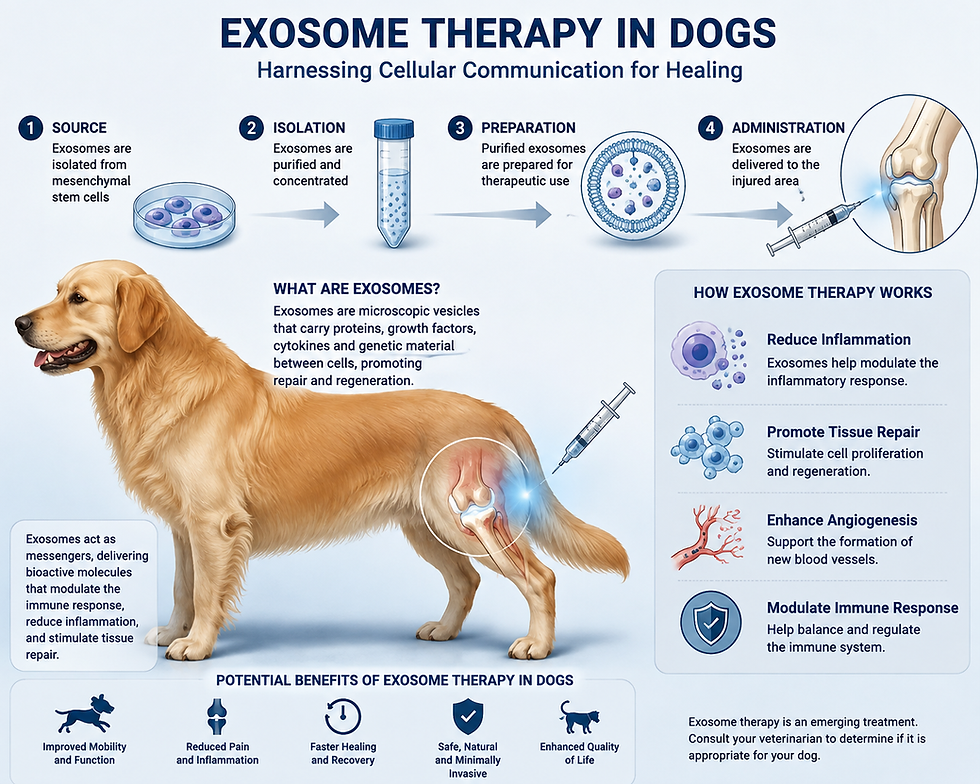
For more than two decades, stem cells have been one of the most exciting frontiers in veterinary regenerative medicine. The idea seemed straightforward: inject stem cells into damaged tissue, allow them to become new cartilage, tendon, or other specialized cells, and watch healing occur.
But science has a way of challenging our assumptions.
Today, many researchers believe that stem cells may not be the primary treatment at all. Instead, much of their therapeutic effect may come from tiny biological messengers they release called exosomes.
If this theory continues to hold true, regenerative medicine may be entering a new era—one where healing comes not from transplanting living cells, but from delivering the instructions those cells naturally use to coordinate repair.
What Are Exosomes?
Every cell in the body constantly communicates with neighboring cells.
One of the most sophisticated ways this happens is through the release of microscopic membrane-bound particles known as extracellular vesicles, with exosomes being one of the smallest and most extensively studied.
Exosomes typically measure 30–150 nanometers in diameter—roughly one-thousandth the width of a human hair.
Think of them as biological delivery packages.
The stem cell acts as the warehouse.
The exosome is the package.
Inside that package are molecular instructions capable of influencing how recipient cells behave.
These packages can contain:
Growth factors
Proteins
Messenger RNA (mRNA)
MicroRNA (miRNA)
Lipids
Cytokines
Other signaling molecules
When an exosome fuses with another cell, it can alter gene expression, protein production, inflammation, and cellular behavior.
Rather than replacing damaged tissue, exosomes appear to help coordinate the body's own healing response.
A Major Shift in Thinking
For years, researchers believed stem cells worked primarily because they became new tissue.
Today, evidence suggests that relatively few transplanted stem cells actually survive long enough to permanently integrate into damaged tissues.
Instead, many appear to act more like temporary biological factories.
They arrive.
Release thousands of signaling molecules—including exosomes.
Then disappear.
This concept is called the paracrine hypothesis, and it has fundamentally changed regenerative medicine.
Instead of asking:
"How do stem cells become cartilage?"
Scientists now ask:
"What messages are stem cells sending that convince the body to heal itself?"
Those messages are increasingly believed to reside inside exosomes.
Why Exosomes Are So Interesting?
Because exosomes contain signaling molecules rather than living cells, they may offer several theoretical advantages.
Potential advantages include:
No living cells that must survive after transplantation
Easier storage and transport
Lower theoretical risk of unwanted cell differentiation
Standardized manufacturing may be possible
Potential for repeated dosing
Reduced immunogenicity compared with whole-cell therapies
Researchers also believe exosomes may avoid some logistical challenges associated with harvesting, expanding, and preserving mesenchymal stem cells.
These advantages have generated enormous excitement in both human and veterinary medicine.
But excitement should never replace evidence.
How Might Exosomes Help Dogs?
Although research is still in its early stages, investigators are exploring exosomes for numerous conditions.
🦴 Osteoarthritis
This is currently one of the most active areas of investigation.
Laboratory studies suggest exosomes may:
Reduce inflammatory cytokines
Protect cartilage cells (chondrocytes)
Encourage cartilage matrix production
Reduce pain-associated inflammation
Influence macrophages toward a more reparative phenotype
Early veterinary studies have reported improvements in pain scores and lameness in some dogs, but most studies involve relatively small numbers of patients.
Larger randomized controlled trials are still needed.
🦵 Tendon and Ligament Injuries
Tendon healing is notoriously slow because tendons have poor blood supply.
Experimental work suggests exosomes may:
Stimulate collagen organization
Promote angiogenesis (new blood vessel formation)
Reduce scar tissue formation
Improve tendon remodeling
These findings remain largely experimental.
🩹 Chronic Wounds
Chronic wounds often become trapped in prolonged inflammation.
Exosomes may help by:
Reducing excessive inflammation
Recruiting fibroblasts
Encouraging new blood vessel formation
Accelerating epithelialization
Improving collagen deposition
Animal studies have shown promising improvements in wound closure, but standardized treatment protocols have not yet been established.
👁 Corneal Ulcers
The cornea must heal with minimal scarring to preserve vision.
Experimental studies suggest exosomes may:
Reduce corneal inflammation
Promote epithelial healing
Improve transparency
Accelerate recovery
Research remains preliminary.
🧠 Spinal Cord Injury
Researchers are also investigating whether exosomes might:
Reduce secondary inflammation
Protect neurons
Support axonal regeneration
Improve functional recovery
Most evidence currently comes from laboratory animal models.
🩺 Kidney Disease
Kidney injury involves inflammation, fibrosis, and cell death.
Experimental exosome therapy has shown potential to:
Reduce fibrosis
Improve tubular repair
Decrease inflammatory signaling
Clinical veterinary evidence remains limited.
Immune-Mediated and Inflammatory Diseases
Because exosomes appear capable of influencing immune signaling, researchers are exploring whether they could eventually help regulate:
Chronic inflammatory diseases
Autoimmune disorders
Immune dysregulation
Fibrotic diseases
Much of this work is still preclinical.
Why Aren't They Standard Therapy Yet?
Despite the excitement, several major questions remain unanswered.
Researchers still do not know:
Which source of exosomes is best
The optimal dose
How often treatments should be repeated
Which diseases respond best
Which patients benefit most
How long effects last
Whether manufacturing can be standardized across laboratories
Unlike traditional drugs, exosome preparations can vary considerably depending on:
Cell source
Culture conditions
Isolation methods
Purification techniques
Storage methods
Two products labeled "exosomes" may contain very different biological cargo.
Regulatory Challenges
Many companies now market exosome products.
However, marketing often advances faster than scientific validation.
At present:
There are no FDA-approved exosome products for treating osteoarthritis or wound healing in dogs.
The FDA's Center for Veterinary Medicine has indicated that animal cell-, tissue-, and cell-derived products—including many exosome-based therapies—are generally regulated as new animal drugs and require appropriate review before legal marketing.
That does not mean exosomes are ineffective.
It simply means the evidence has not yet reached the level required for regulatory approval.
Promise Versus Proof
This is an important distinction.
The science surrounding exosomes is genuinely exciting.
Laboratory research is robust.
Early veterinary studies are encouraging.
Mechanistically, the biology makes sense.
But promising biology does not always translate into meaningful clinical benefit.
Veterinary medicine has seen many therapies with impressive laboratory results fail to produce substantial improvements in large clinical trials.
That's why carefully designed randomized controlled studies remain essential.
What Should Pet Owners Know?
If you're considering exosome therapy for your dog, ask your veterinarian:
What evidence supports this treatment for my dog's condition?
What outcomes should I realistically expect?
Are there published clinical trials?
What are the known risks?
Is this considered experimental?
How will success be measured?
An informed conversation is always the best starting point.
Looking Ahead
Exosomes represent one of the fastest-growing areas of regenerative medicine.
They are changing how scientists think about healing—not as replacing damaged tissue, but as restoring the body's own ability to repair itself.
If future clinical trials confirm today's early findings, exosomes could become an important addition to veterinary medicine.
For now, they remain a promising technology supported by compelling biology and encouraging preliminary studies—but one that still requires rigorous clinical validation before becoming routine care.
Sometimes the biggest breakthroughs don't come from discovering new cells.
They come from discovering the messages those cells have been sending all along.
References
Théry C, Witwer KW, Aikawa E, et al. Minimal information for studies of extracellular vesicles 2018 (MISEV2018): a position statement of the International Society for Extracellular Vesicles. J Extracell Vesicles. 2018;7(1):1535750.
Kalluri R, LeBleu VS. The biology, function, and biomedical applications of exosomes. Science. 2020;367(6478):eaau6977.
Pegtel DM, Gould SJ. Exosomes. Annu Rev Biochem. 2019;88:487–514.
Witwer KW, Théry C. Extracellular vesicles or exosomes? On primacy, precision, and popularity influencing a choice of nomenclature. J Extracell Vesicles. 2019;8(1):1648167.
El-Tookhy OS, Shamaa AA, Shehab GG, et al. Mesenchymal stem cell-derived exosomes in regenerative medicine: current applications and future perspectives. Stem Cell Research & Therapy. 2024.
Varela-Eirin M, Loureiro J, Fonseca E, et al. Mesenchymal stem cell-derived extracellular vesicles in musculoskeletal regeneration. International Journal of Molecular Sciences. 2020;21:4277.
Ferguson SW, Nguyen J. Exosomes as therapeutics: the implications of molecular composition and exosomal heterogeneity. Journal of Controlled Release. 2016;228:179–190.
U.S. Food and Drug Administration, Center for Veterinary Medicine. Animal Cells, Tissues, and Cell- and Tissue-Based Products (ACTPs): Guidance for Industry. Current regulatory guidance.


Comments