Shockwave Therapy for Dogs: Does the 2026 Evidence Change What We Know?
- steve mehler
- 6 days ago
- 3 min read
By Steve Mehler, DVM, DACVS
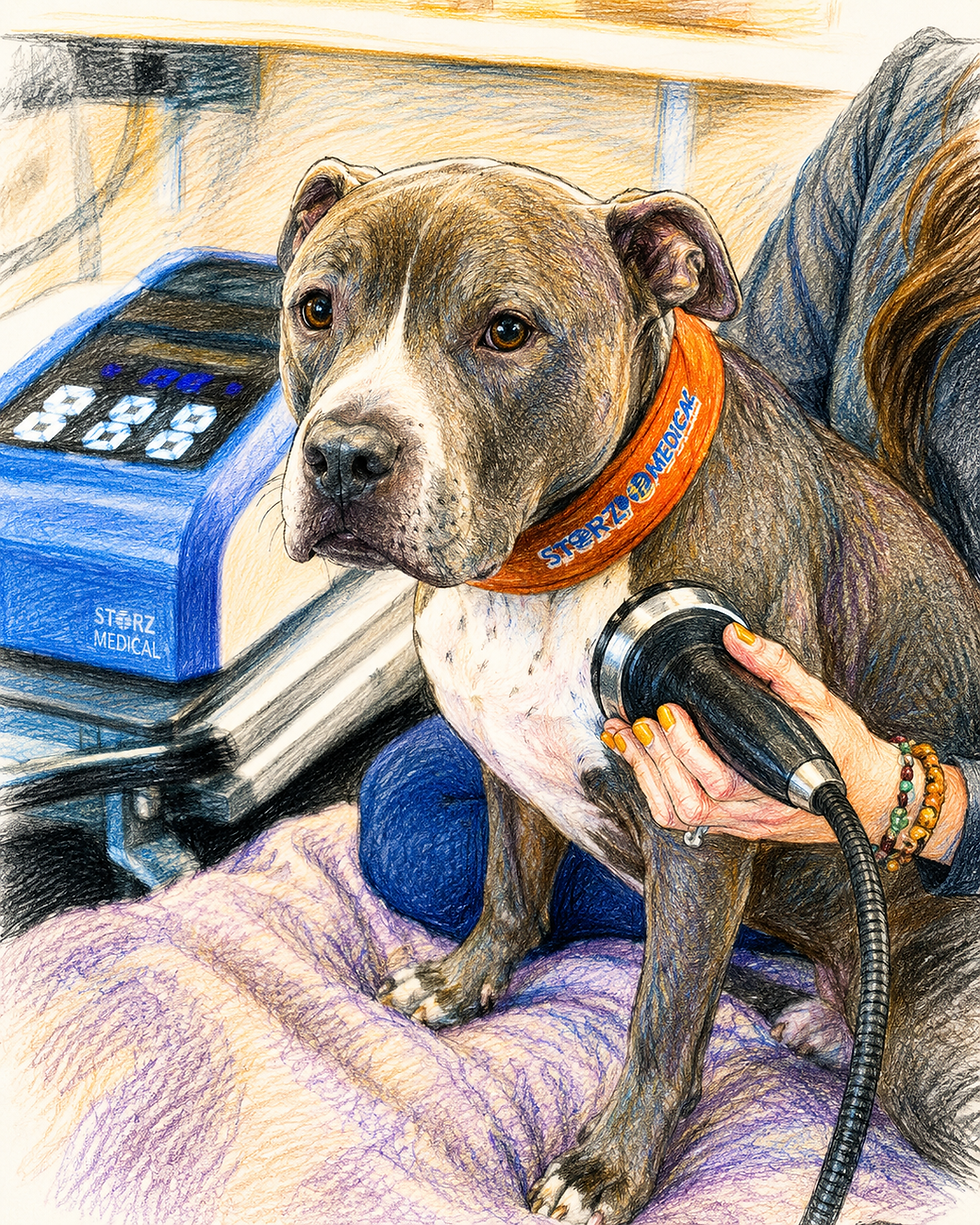
Extracorporeal shockwave therapy (ESWT) has become an increasingly popular treatment in veterinary rehabilitation and sports medicine. Marketed as a non-invasive way to reduce pain and stimulate healing, shockwave therapy is now offered by many specialty hospitals for dogs with osteoarthritis, tendon injuries, ligament injuries, and chronic musculoskeletal pain.
But does the science actually support its use?
A randomized clinical trial published in 2026 provides some of the strongest evidence to date—and the results are more nuanced than many advertisements might suggest.
What Is Shockwave Therapy?
Shockwave therapy uses high-energy acoustic waves that travel through tissues. Unlike ultrasound, these are brief, high-pressure mechanical pulses that stimulate a biological response within damaged tissues.
Researchers believe ESWT may:
Stimulate blood vessel formation (angiogenesis)
Increase production of growth factors
Reduce inflammatory mediators
Influence nerve signaling to decrease pain
Promote remodeling of tendon, ligament, and bone tissue
Importantly, shockwave therapy does not “break up scar tissue” or “heal arthritis.” Instead, it appears to alter the biological environment in ways that may improve pain and function.
The Biggest Canine Study Published in 2026
A randomized, double-blinded clinical trial evaluated 24 client-owned dogs with severe, treatment-refractory elbow or stifle osteoarthritis.
These were not mildly arthritic dogs. Every patient continued to have significant clinical signs despite conventional treatment.
Dogs were randomly assigned to receive:
One focused shockwave treatment
Two treatments approximately four weeks apart
Investigators measured:
Owner pain questionnaires
Mobility scores
Veterinary orthopedic examinations
Objective force plate gait analysis
The goal was simple:
Does giving additional shockwave treatments improve mobility in dogs with advanced arthritis?
What Did They Find?
The results were encouraging—but far from miraculous.
Many dogs experienced improvement in pain and mobility following treatment.
However:
Improvements were generally modest
Benefits varied considerably between dogs
Objective gait improvements were inconsistent
Two treatment sessions appeared to produce slightly more consistent improvements than a single treatment, although responses remained variable.
This is an important distinction.
Shockwave therapy is not a cure for osteoarthritis.
Instead, it appears to function as another tool that may reduce discomfort in selected patients.
Why Doesn’t Every Dog Improve?
Osteoarthritis is a complex disease.
Pain comes from many different tissues, including:
Synovium
Joint capsule
Subchondral bone
Ligaments
Muscles
Central nervous system sensitization
Because shockwave primarily targets local tissue biology, dogs with widespread chronic pain or advanced structural degeneration may experience less dramatic improvement.
Age, body weight, muscle loss, concurrent disease, and rehabilitation programs also influence outcomes.
Earlier Research Told a Mixed Story
The 2026 trial did not appear in isolation.
Earlier studies have shown conflicting results. Some investigations demonstrated meaningful improvements in elbow osteoarthritis, while others found little benefit for stifle arthritis.
Systematic reviews have consistently concluded that the overall quality of veterinary evidence has been limited by:
Small sample sizes
Different treatment protocols
Different energy settings
Variable outcome measurements
Short follow-up periods
The new randomized trial strengthens the evidence base but also confirms that shockwave therapy is not universally effective.
Where Shockwave Therapy May Be Most Useful
Current evidence suggests shockwave therapy may be most appropriate for dogs with:
Chronic elbow osteoarthritis
Chronic stifle osteoarthritis
Tendinopathies
Certain ligament injuries
Insertional tendon disease
Patients that cannot tolerate higher doses of NSAIDs
Many rehabilitation specialists also use ESWT alongside:
Weight management
Therapeutic exercise
Underwater treadmill therapy
Physical rehabilitation
Pain medications
Anti-NGF therapy when appropriate
Rather than replacing these treatments, shockwave is best viewed as one component of a multimodal treatment plan.
Is It Safe?
Shockwave therapy is generally considered very safe.
Most dogs experience only mild, temporary soreness after treatment.
Depending on the equipment and energy settings used, some dogs require sedation while others can be treated awake.
Serious complications are uncommon when treatments are performed appropriately.
The Bottom Line
The 2026 randomized clinical trial provides the strongest evidence yet that extracorporeal shockwave therapy can improve pain and mobility in some dogs with advanced osteoarthritis.
The improvements, however, were generally modest and inconsistent.
For veterinarians and owners, the message is clear:
Shockwave therapy should not be viewed as a miracle treatment or a replacement for comprehensive arthritis management.
Instead, it is another evidence-based option that may help carefully selected patients as part of a multimodal approach.
As additional large clinical trials are published over the next several years, we’ll gain a better understanding of which dogs are most likely to benefit, the ideal treatment schedule, and how shockwave therapy should be integrated with rehabilitation, medications, and emerging regenerative therapies.
References
Klein A, Winkler EV, Zablotski Y, Mille MA, Volz F, Lauer SK. Effects of Extracorporeal Shockwave Therapy on Pain and Mobility in Client-Owned Dogs with Refractory Elbow and Stifle Osteoarthritis: A Randomized Double-Blinded Trial. Animals. 2026. (MDPI)
Boström A, et al. Extracorporeal Shockwave Therapy: A Systematic Review of Veterinary Applications. Veterinary and Comparative Orthopaedics and Traumatology. 2022. (PMC)
Dahlberg J, et al. The Evaluation of Extracorporeal Shockwave Therapy in Canine Stifle Osteoarthritis. 2005. (PubMed)


Comments